


Above a kitchen island, pendant lights are not just there to illuminate the countertop. They highlight its proportions, add rhythm to the room, and create a visual link between the kitchen and the living spaces surrounding it.
In the majority of kitchens, plan for one pendant light for a small island, two for an island between 140 and 200 cm, and three for those over 200 cm. These guidelines must, however, be adapted to the diameter of the fixtures, their material, and the desired decorative effect.
The rule to remember
A single pendant generally suits an island under 120 cm. Two pendants offer a good balance between 140 and 200 cm. For an island longer than 200 cm, a composition of three fixtures helps to accompany its entire length.
How many pendant lights to choose based on island length?
The length of the island is the primary reference point. However, it is not enough to determine the number of fixtures on its own. A pendant 40 cm in diameter does not occupy the same space as a series of small 15 or 16 cm models.
| Approximate island length | Recommended composition |
|---|---|
| Up to 120 cm | One central pendant |
| From 120 to 160 cm | One large pendant or two small formats |
| From 160 to 200 cm | Two pendants |
| From 200 to 300 cm | Three pendants |
| More than 300 cm | Three large fixtures or a composition suited to the volume |
These values serve as a starting point. A large pendant may be enough above a fairly short island, while a series of small fixtures creates a more graphic rhythm over the entire length.
A single pendant for a small island
For an island less than 120 or 140 cm, a single pendant is usually sufficient. Placed in the center, it visually brings the ensemble together and avoids cluttering a small kitchen.
This solution works particularly well with a fixture whose silhouette is present enough to engage with the volume of the piece of furniture.

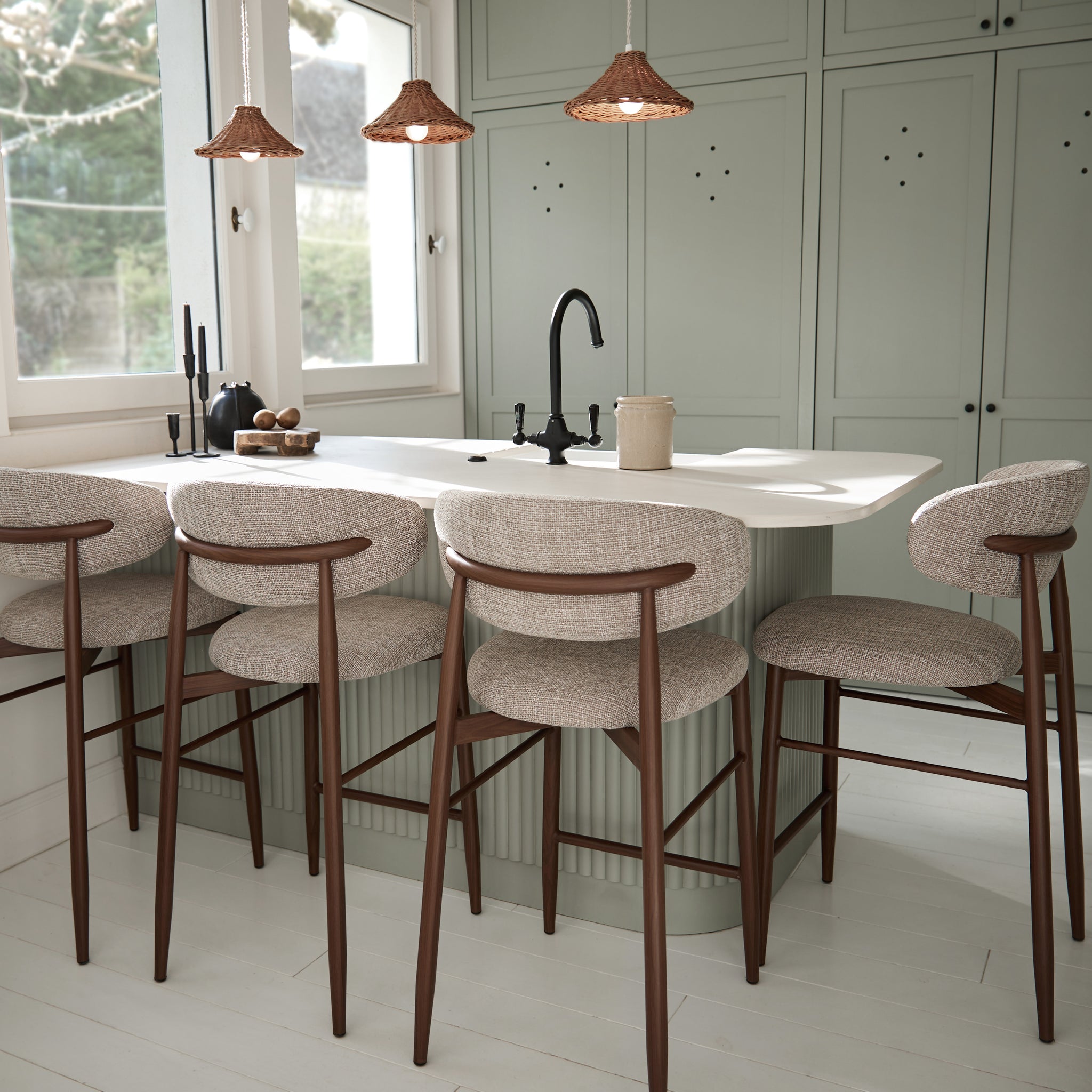
The rattan weave creates a warm presence without forming an opaque mass. The 40 cm size, in particular, can serve as a visual landmark above a compact island.
A single pendant also allows for playing with contrasts. A natural material will soften smooth cabinet fronts, a stone countertop, or metallic elements.
Two pendants to create a balanced ensemble
Two pendants make up the easiest composition to integrate above a medium-sized island. They distribute the gaze across the entire length of the piece while maintaining an impression of calm.
This arrangement is particularly suitable for islands between 160 and 200 cm. It also works on slightly shorter models when the fixtures remain compact.
To obtain a coherent look, choose two identical pendants and place them at the same height. The repetition of the same silhouette creates a structured composition.

Its conical shape visually directs light toward the tabletop. The brass introduces a golden hue that warms up kitchens featuring wood, light stone, off-white, or deeper tones.
The small size measures approximately 25 cm wide. The larger size reaches about 34 cm wide. Two pendants of the same size will produce a calm result, while combining the two formats will add more movement.
Three small pendants to accompany a large island
From 200 cm in length, three pendants allow for better occupancy of the space and create a regular rhythm. An odd number often results in a natural composition, with a central fixture surrounded by two identical models.
The more numerous the pendants, the more their dimensions should remain measured. A series of compact models avoids creating a line that is too heavy above the work surface.

Its small size lends itself to a composition of three fixtures. The glazed porcelain diffuses a soft light and brings a clean presence without excessively occupying the volume.
The repetition of the same model also showcases its ribbed relief. Placed at the same height, the three pendants draw a regular line that naturally follows the island.
Two fabric pendants for softer light
Textile materials create a more enveloping ambiance. They can soften a kitchen composed of mineral surfaces, very smooth cabinet fronts, or metallic elements.

Its 16 cm diameter allows it to be installed in pairs above a medium-sized island or in threes above a longer surface. The cream shades maintain a discreet presence and easily blend with natural materials.
Since each piece is made from antique fabrics, variations in texture and finish contribute to its character. This irregularity should be considered a component of the composition.
How to space two or three pendants?
The spacing should allow each fixture to exist without giving the impression that the pendants are isolated from one another.
With two pendants, visually divide the island into two equal parts and place each fixture in the center of one. With three models, use the same principle by dividing the length into three zones.
An interval of 50 to 80 cm between the centers of the pendants is generally a good benchmark. This distance should be adjusted to their actual width.
Also, leave a sufficient margin at both ends of the island. A pendant installed too close to the edge will give the impression of falling out of the composition.
Our advice
Before definitively choosing the number of pendants, visualize their diameter with pieces of cardboard. Temporarily hang them above the island to observe the proportions from the kitchen, the dining room, and the living room.
How does diameter influence the number of pendants?
The number of fixtures cannot be dissociated from their dimensions. The wider a pendant is, the less necessary it is to multiply the number.
On a 180 cm island, two medium-sized brass pendants can form a balanced composition. With small 15 or 16 cm models, a series of three fixtures may be more coherent.
Material also changes the perception of volume. Woven rattan lets the gaze pass through. Fabric filters light softly. Brass and porcelain create a cleaner, more contrasted silhouette.
At what height should pendants be placed above the island?
The bottom of the pendants is generally placed between 75 and 90 cm above the tabletop. This distance preserves a visual relationship between the fixture and the island without hindering people sitting or standing around it.
The various fixtures are most often installed at the same height. This alignment reinforces the rhythm and provides an impression of stability.
A slight stagger can work when combining the two sizes of the brass pendant or several pieces with slightly irregular contours. The difference must remain subtle so as not to unbalance the ensemble.
Should you choose identical pendants?
Identical pendants are the simplest choice for achieving a coherent ensemble. Repetition of shape and material structures the island and brings continuity to the kitchen.
It is nonetheless possible to combine several sizes of the same fixture. The brass pendant lends itself particularly well to this composition since it exists in two formats sharing the same silhouette.
Mixing very different models requires more restraint. To preserve unity, keep at least one common element: a color, a finish, a material, or a general shape.
Which material to choose above an island?
The choice depends on the ambiance of the kitchen and the materials already present.
Woven rattan adds natural texture and warms up smooth surfaces. Brass creates a more assertive contrast and reflects golden light. Glazed porcelain offers a clear and precise presence. Cream fabric filters light more and softens volumes.
In a kitchen rich in materials, a pendant with a simple silhouette helps maintain balance. In a more streamlined space, the relief of the weave, the ribbing of the porcelain, or the nuances of brass can provide the necessary character.
Frequent errors to avoid
Multiplying small pendants
An overly dense succession can clutter the island and visually reduce the room's height. Three well-proportioned fixtures are often more harmonious than five small models.
Choosing fixtures that are too small
Small-diameter pendants placed very far from each other will seem lost above a large island. In this case, move them closer together, increase their number, or choose a more generous format.
Forgetting the rest of the kitchen
Pendants must interact with stools, cabinet fronts, the backsplash, and neighboring light fixtures. A successful composition is never judged independently of its environment.
Centering fixtures in the room
Pendants must be centered over the island, even when it is offset in relation to the ceiling or the rest of the kitchen.
Mixing too many shapes and materials
The island is already a visual focal point. An accumulation of very different silhouettes can confuse the room's design. Regular repetition generally remains more calming.
How many pendants to choose in the end?
For a small island, one central pendant is usually sufficient. On an island 160 to 200 cm long, two fixtures create a natural balance. Islands over 200 cm easily accommodate three more compact pendants.
These reference points must always be adjusted to the dimensions and visual presence of the chosen models. Two brass pendants will strongly structure the space, while three small ribbed pendants will form a lighter line.
The right number of pendants is the one that accompanies the island without trying to fill the entire ceiling. The composition should bring rhythm to the kitchen, diffuse pleasant light, and let the volumes breathe.
Frequently asked questions about pendant lights above an island
How many pendants are needed above a 180 cm island?
Two pendants generally suit a 180 cm island. Choose medium-sized models and distribute them regularly along the length.
How many pendants to install above a 2-meter island?
Two fairly substantial pendants or three small models may suit a 2-meter island. The choice depends mostly on their diameter and material.
What distance to leave between two pendants?
Generally plan for between 50 and 80 cm between the centers of two pendants. Increase this spacing when the lampshades are particularly wide.
At what height to place the pendants above the island?
The bottom of the fixtures can be placed between 75 and 90 cm above the tabletop. Adjust this height according to their volume and the use of the island.
Must pendants be perfectly aligned?
Alignment at the same height offers the calmest and most structured result. A slight stagger is possible when multiple sizes of the same model are combined.
Can one single pendant be placed above an island?
Yes. A single pendant can be enough for a short island, especially when it has a diameter generous enough to remain proportional to the tabletop.
Should pendants be centered on the island or the room?
Pendants must be centered in relation to the island. Their role is to illuminate it and highlight it, even when it is not placed in the center of the kitchen.
